Showing posts with label sti. Show all posts

Saturday, 24 June 2017

Tianjin Zhongxin Pharmaceutical (T14.SI)

Tianjin Zhongxin Pharmaceutical (T14.SI) is engaged in the development, manufacture and distribution of mainly Chinese traditional medicine. In addition to Chinese medicine, its products also include distribution of Western medicine operated jointly with pharmaceutical giants like GSK and Baxter.

Pharmaceuticals in SGX are far and few between and Tianjin ZX certainly piqued my interest. It first appeared in my radar while searching for stocks that have not ran up in this bull market, dividend-yielding, EPS growth in the past 5 years, reasonable market capitalization and in profit. Among all the stocks that appeared, Tianjin ZX had a good economic moat expected. of a pharmaceutical firm.

Digging up the past year's performance, Tianjin ZX was quite impressive as well.


In 2010, the Company reported 0.4 RMB in earnings. This rose to a high of 0.6 RMB in 2015 before dipping to 0.55 RMB in 2016. As shown in the graph above, NAV displayed an even better result. The Company grown from 2.43 RMB in 2010 to 5.38 RMB in 2016. This represent a CAGR growth of 14.16%.

S-chip is still viewed suspiciously by many in Singapore. Most recently, Eratat declared that it has no assets to be distributed to shareholders and delisted without any resolution to them. The cash declared to be held in banks were non-existent. However, Tianjin ZX pays a steady dividend year and this should imply that the cash were certainly present. For year of 2016, Tianjin ZX paid a dividend of 0.25 RMB. This is subjected to a 10% tax rate in Singapore and should amount to a final dividend of 0.225 RMB. At my buy price of 0.965 USD, this will translate to approximate yield of 3.4%. 

At current valuation, Tianjin ZX has a P/E of 11. For a pharmaceutical company, this P/E is somewhat low and have upside potential. For the latest quarter, the Company holds 536,481,000 RMB of cash, approximately 10% of share price. However, the crux of my purchase lies in this fact. Tianjin ZX is also listed in Shanghai at 17.65 RMB or S$3.58. At 0.US$965 or S$1.35, Tianjin ZX is listed in SGX at a 62% discount and 31.52 P/E!!!! I do not understand what caused the extent of this different valuation. However, I do hope that management will buyout my shares in and relist them at Shanghai for better returns. 

All this said, Tianjin ZX has been facing lower revenue but have been compensating by increasing operating efficiency and cost-cuts, leading to higher gross profit margins. In the latest quarter results, Tianjin ZX revealed that it is under challenging economic conditions and competitive environment. It is aiming to overcome these with the following actions:
  1. Placing greater emphasis on innovation and creation and establishing the importance of scientific development; 
  2. Strengthening its marketing plans to increase the amount of industrial sales so as to create more profits for the Company; 
  3. Focusing on research and development activities to enhance the Group’s core competitiveness in technology; 
  4. Strengthening the internal controls and management of the Group
Writing this post, I hope that Tianjin ZX will be deserving of my long-term investment and reap future returns. 


Thursday, 9 July 2015

Singapore Post (S08.SI)

Sustainability of dividend

I like dividend stocks. The money is better in my pocket and tangible rather than getting stuck in the company balance sheet. That is the reason why I like Singpost so much. Having bought Singpost at $0.98 and yielding 6.25c dividend then, it was giving me 6.37% dividend yield. Recently, management raised dividend to 7c, amounting to 7.14% yield. While I welcome the dividend bump, I worry that it may not be sustainable. Many companies spam lots of dividend only to abruptly stop the flow of money when the cash pile depletes.

I've compiled the changes in the cash pile of Singpost over the years and displayed it in the chart below.


As one can see, there is no definite pattern in the change of cash positions year to year. However, it can be seen that the data is skewed towards net increase. Even it out over the years, Singpost has actually increased its cash pile despite giving generous dividends. Increasing yearly dividend by 0.75c will only increase cash demand to the tune of $16.1m (based on outstanding shares of 2,146,774,225). That is less than 10% of the net cash increase during the latest financial year. Therefore, I would conclude barring unforeseen circumstance, Singpost is in good position to service that additional dividend payout.

P/E and P/B valuation


For the full year ended 2014, the EPS was 6.849c. Based on the price of $1.90, Singpost currently has a P/E of 27.7. The P/E is admittedly on the high side as I am more comfortable with stocks with P/E below 20. 

Net asset value per share was 68.40c. P/B is 2.78. Similarly I'm usually not comfortable with P/B value above 1. When trawling the market for gems, I will look for P/B < 1 for safety margin and also for bargain. 

From P/E and P/B valuation point of view, Singpost is indeed overvalued. A P/E of 27 is usually accorded to company with growth potential. Even though Singpost increased its revenue by 12% for the whole year, its underlying net profit only increased by 5.2%. This can be attributed to the low profit margin associated with the Logistics business Singpost is diversifying into. Mail segment is stagnating for a few years but is sadly, the cash cow of Singpost. Can such a high share price justify the high revenue growth but low bottomline growth of Singpost? 

I would hold the stock myself since I bought it low and yield from my capital outlay is good. However, looking at valuations, Singpost is currently overpriced and there are better dividend yielding stocks out there.

Acquisitions and Disposals


In times of boom, companies had been known to go on an acquisition spree only to find that they had overpaid. Singpost, in its bid to diversify from its traditional mail business, had gone through a restructuring. The restructuring included acquisitions of logistics company and disposals of some traditional businesses, together with joint ventures and investments from Alibaba. I'm mainly concerned with the pace of acquisitions and the price that the management paid for the companies. Here's the rundown of the acquisitions and disposals Singpost did for the past year. 

Acquisitions
  • The Store House1
    • Paid S$121,000 for 75% of shares with net tangible asset last recorded as S$11,000
  • F.S Mackenzie2
    • Consideration up to S$14.8m for entire paid up share capital
    • Net asset value was S$5.4m 
  • Couriers Please Holdings3
    • Acquisition at S$105m with prior net tangible asset recorded at roughly S$3m
    • From the change in net profit after acquisition, it seems that Couriers Please Holdings added $9,417,000 to the net profit of Singpost (if assumption is correct, the P/E at which Singpost paid for Couriers Please seems reasonable)
  • Famous Pacific Shipping4
    • 90% holdings for NZ$3.6m with potential consideration up to NZ$8m because of potential earn-out consideration (don't really know what earn-out consideration is)
    • Net asset value is NZ$816,104
  • Hubbed Holdings5
    • Quantium Solutions (Australia) acquired 30% of Hubbed Holdings for S$4.6m
    • Quantium will get 5% more shareholdings if some pre-determined performance benchmark not met. If performance met, Quantium will pay an extra S$1.06m
    • Net asset value of Hubbed Holdings is roughly S$1m 
Disposals
  • Novation Solutions & DataPost (HK)6
    • Entirely disposed of both assets for $24,388,951
    • Net tangible asset recorded as $19,214,000
  • DataPost Pte Ltd7
    • Sold 90% of shares for $39,299,511
    • Net tangible asset was recorded as $30,690,000 
I see that what Singpost paid was consistently much higher than the net asset value the acquired company possessed. However, I also feel that book value of company is not a good gauge for valuation the companies. Singpost itself is valued at nearly 3x P/B. Instead, the EPS of the company would be a better guide to see value. I will appreciate announcements to be like that of Couriers Please where impacts to net profits were shown. Looking at the announcement details, it would seem Singpost paid a reasonable price for Couriers Please and I would hope to extrapolate it to the other acquisitions. 

With the exception of Couriers Please, the other acquisitions were relatively small and should not impact Singpost greatly if it was a bad investment. Furthermore, the capital expenditure for acqusitions is supported by disposals of companies whose considerations were significant. 

From what I heard at Singpost's AGM, the M&A actions are not likely to stop just yet and there are more to come. Chairman was very supportive of the director that oversees M&A.

Earnings


As mentioned at the AGM, revenue rose 12% to the highest ever at S$920m. Underlying net profit similarly rose 5.2% to S$157m, highest ever.  I am disappointed that profit has not kept up with the growth of revenue. This was actually mentioned at the AGM with one lady pointing out that net profit actually decreased. CEO of Singpost reasoned forcefully that in the process of transforming Singpost, there were many charges that cut into profits. They had to strip them out to show that the core businesses were actually doing well. 

What was impressive about CEO Wolfgang Baier, was that he acknowledged the Mail business of Singpost was declining and never going back. 150 years of good business, it's not going to improve. Instead, Singpost had to transform to maintain its competitiveness. I liked his pragmatism and honesty. That is how problems get solved. Many management refused to acknowledge problems and refuse to change or improve. It was my first time attending an AGM and I was really impressed with the management, replying tough questions cordially and directly.


Conclusion


My confidence with Singpost remains strong especially after witnessing the strength of the management. On the day of AGM, it was announced that Alibaba invested a further S$279m in Singpost. Chairman kept reiterating that Alibaba was a tough investor to satisfy. Given that Alibaba had given Singpost their stamp of approval, I will likewise trust my investment in Singpost. 

I will continue monitoring the growth of profit along with growth of revenue. It has been almost 2 years where profit growth had disappointed me. Perhaps at some point, I will realise Singpost is not going to be as profitable as before, but the time is not now. 

Since buying Singpost at 2012, the dividends had paid almost 20% of my initial investment. Hopefully I will hold it till the stock pays itself. While I am not going to sell my holdings anytime soon, I think ultimately at $1.90, Singpost is overvalued and not a value buy for buyers. Dividend yield stands at 3.7% and while this is respectable, there are better companies out there that provides better yield and growth opportunities. Hence, people looking at Singpost, just pray it may drop. I may also increase my shareholdings if it ever drop low enough! (at least 5% div yield). 


Thursday, 25 June 2015

My Stock Holdings (June)

June has been a busy period for me as I was busy packing stuff to go back to Singapore. It seemed that this month has been a volatile month due to the effect of Greece flirtation with the possibility of default.

ST Eng's price was pushed to a low of 3.24 before recovering recently to above 3.3, which is my average buy-in price. Many people in forums have expressed the opinions that ST Eng is richly valued in terms of P/E and P/B. I had see that the valuations are rich but dividend yield remains good. Given time, perhaps I'll see whether its dividend policy is sustainable and whether cash holdings is decreasing. 

Singpost also recovered its price dip to above 1.90. This can be attributed to annual dividends increasing to 7c from 6.25c previously. Also, it divested some of its traditional business for a profit and that might also had lead to price increase. There's some points I'd like to read up on Singpost given time and they are listed as follows: 
  • Sustainability of dividend
  • Debt obligations and dividends against earnings
  • P/E and P/B valuations (Benjamin Graham had advocated sale of share when it reaches overvaluation state. Therefore, I want to see if Singpost is grossly overvalued and warrant a sale. It is unlikely though, as I regard Singpost as my crown jewel. I know falling in love with stock is no good..)
  • Review growth of earnings (can be quite hard as Singpost recently changed its accounting practice)
Lastly, HPH Trust has been slowly dipping through the month of June while Bank of Ireland closed pretty high at the end of June amidst signs of Greece coming out of the talks with a solution. 


There was no dividend issued for the month of June. Hence, dividend received remains at $278.25


**Edit: Chart removed because I set it to update with latest information -- not accurate info

Wednesday, 13 May 2015

My Stock Holdings (May)

Many companies are reporting their financial results this month and this lead to some price fluctuations. In my portfolio, all had reported their results with the exception of Bank of Ireland. As of now, I have no intention to sell any stock in my holding based on the results. Hence barely any change in the composition of my holding.

Also, I'm scouting for good stock to add to the portfolio and will buy in when I return to Singapore from my exchange.

One of my criteria for buying a stock is that it must give out dividend. Singpost, ST Eng and HPH Trust gives out dividend in my portfolio. Bank of Ireland is an exception as I recognise that it is a high growth stock and does not necessarily need to give out dividend.

As of May 2015, I received a total dividend of $278.25

**Edit 1: Revised dividend amount to a lower value as I accidentally calculated dividends I haven't receive.

**Edit 2: Chart removed because I set it to update with latest information -- not accurate info

Saturday, 13 December 2014

Hutchison Port Trust (NS8U.SI)


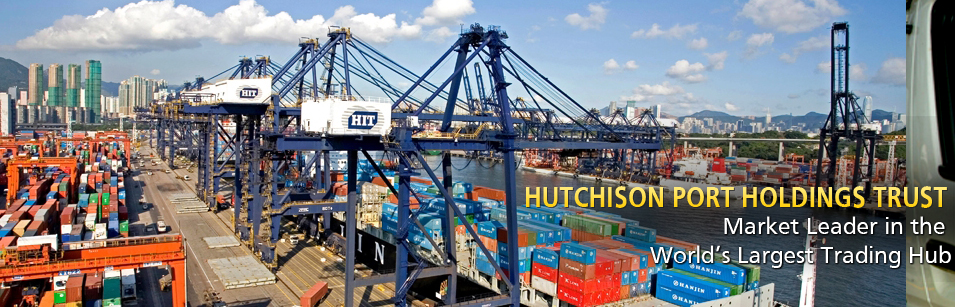
Hutchison Port Trust (HPH Trust) started trading with much fanfare on 2012. Listed in SGX, it is touted as the world's first publicly traded container port business trust. HPH Trust owns interest in container port assets in Hong Kong and Shenzhen - two of the busiest ports in the world. In 2013, its container berth handled a combined throughput of 22.8m twenty-foot equivalent unit (TEU).

HPH Trust is one of the thirty components in Straits Times Index (STI), having replaced F&N in 3 April 2013. As of 13 December 2014, it is also the highest yielding stock within STI at 7.8%. On 27 October 2014, the company ended the third quarter with an operating profit of HK$1.24 billion, a 3.5% increase year-on-year.

Given the high dividend that HPH Trust pays out every year, one should be prudent and check whether these dividends are sustainable into the future. The key objective of the Trustee-Manager was stated in the 2013 Annual Report as the following: "... to provide unitholders with stable and regular distributions and long-term growth in distributions per unit (DPU)" However, a quick look at the DPU since IPO was actually decreasing.

This also points out the deceptive nature of dividends yield. Dividend yield is based on past dividends and definitely not indicative of future dividends. Furthermore, dividend yield is based on current stock price and this means that falling stock price inflates dividend yield. For instance, HPH Trust indicated that it is distributing 45.88 HK cents in its IPO Prospectus and that translated to 5.8% dividend yield based on IPO price of US$1.01. However, due to the subsequent price fall to US$0.78, the yield had been bumped up to 7.5%. Hence, a lesson to take home is that stock purchase should not be based solely on the dividend yield number.

Besides the falling distributions, there are also a few points that does not paint a rosy picture of its financials. The first point is the enormous payout ratio. In 2011, the payout ratio is 167%. Next year, it increased to 199% and subsequently stood at 213% in 2013. Such high numbers indicated the distributions were likely unsustainable and that might have been the reason why distributions were falling. 

The trust might be able to give out that much dividends with its positive operating cash flow but quick inspection of the cash pile over the years indicated that it is dipping into its coffers to give such high dividends. In other words, the distributions for the past 3 years are unlikely to be sustainable. The Trust must find ways increase its profits otherwise unitholders will be looking at reduced distributions.

Another point of concern is the liabilities of the Trust. While the debt to assets ratio are pretty reasonable at below 50%, we can see that significant portion of the liabilities have been transferred to Current Liabilities recently. Current Liabilities are debts and obligations due within one year and with significant increase in that amount, a cut in dividend might be plausible in the near future. 

With all these data, is HPH Trust properly valued at US$0.69? Analysts opinions were quite differing with UBS having at TP of US$0.67 and DBS at US$0.78. However, one common point in both reports was that the management was considering whether to match cash flow generation to distribution payout more closely. Given that cash flow were negative in 2012 and 2013, distributions look to be suppressed in the mid- to long-term.  

Having bought HPH Trust at US$0.68 way back in 21 November 2013, I am fairly pessimistic about the dividend outlook. However, since I am comfortable with dividend yield above 6.5%, I will hold on to it until capital gains (around US$0.725) justify me switching out to other dividend stocks.  

Sunday, 7 December 2014

ST Engineering (S63.SI)

Amidst the recent drop in oil prices, there are gems to be found. Some are oil-related stocks like Keppel Corp which may or may not have been oversold compared to crude oil price. Others, like ST Engineering (S63.SI) are dragged down by the pessimistic market. Upon some search on how oil price affects the business of ST Eng, I found this statement in the company's 2009 annual report:

"Oil prices have been on the uptrend since the beginning of the year and was around US$70 at year’s close. High oil prices would have a negative impact on the Group’s customers in the Aerospace sector, and this may in turn impact the Group’s performance. However, such an environment of high costs could present opportunities for third-party MRO providers like ST Aerospace, as airlines outsource more MRO work in an effort to contain costs." 

Although a report in 2009 is too outdated for my liking, I will conclude that oil price does not affect the company negatively at the very least. Due to its slump in stock price, the dividend yield had been bumped up to 4.7% from 4+% previously. Attractive, in my opinion.

However, as fate would have it, I chanced upon an article which highlighted the hidden risk of dividend stocks. In the article, SIA Engineering was cited as an example where high dividend payout did not mean that it was a good buy. This was due to its unsustainable dividend policy where dividends regularly exceeds its earnings. The shortfall between earnings and the dividends have to been patched up using its cash pile.

Following what the article did, I went to compile a list of ST Eng's financial and dividend history as below.
Financial Stats
Year EPS (cents) NAV (cents) Dividends (cents) Payout Ratio
2004 12.26 47 12.39 101.06%
2005 13.64 51.2 13.6 99.71%
2006 15.15 53.1 15.11 99.74%
2007 16.95 54.7 16.88 99.59%
2008 15.82 52.7 15.8 99.87%
2009 14.78 52.09 13.28 89.85%
2010 16.21 53.38 14.55 89.76%
2011 17.28 57.79 15.5 89.70%
2012 18.76 61.51 16.8 89.55%
2013 18.73 68.14 15 80.09%

The Earnings Per Share has been increasing steadily throughout the years with a slight bump in the wake of 2008 Financial Crisis. Dividends had been steady since 10 years ago. With decreasing payout ratio, it seemed that ST Eng had been prudent with its cash pile. This also implies that ST Eng does not need to dip into its cash reserves in order to maintain same dividend payout even if EPS drops. ie Sustainable Dividend Policy
Having bought half a lot of ST Engineering at $3.37, I would seek to complete my other half of the lot by waiting at $3.24. ST Engineering is a very solid company as I see it as a company that is effectively backed by SAF. During NSF days, almost all the vehicles were serviced or modified by ST Kinetics, a subsidiary of ST Engineering. Following Warren Buffet's advice, I would still see ST Engineering existing 50 years down the road and thus bought the stock amidst some market turmoil. 

Sunday, 9 November 2014

Investing Report Card

Amidst the lab reports, presentation, projects and upcoming exams, this post was done up in light of my third year anniversary in investing.

My first transaction was done back in 8 November 2011 with the purchase of STI ETF. Throughout these 3 years, I had recorded and subsequently archived all my stock holdings with no way of finding out how well I fared against the market index. However, I recently discovered that I could track the CAGR of my portfolio using the XIRR function within Microsoft Excel and thus started to input my transaction history in the spreadsheet.


XIRR function works by inputting two sets of data, transaction value and date (this is reflected by column A and column B as shown in the picture). There are also a couple of rules to follow in order for the function to work. 
  1. Beginning value of portfolio must be positive
  2. Any "deposit" into the portfolio must be keyed in as a positive value
  3. Conversely, any withdrawals (sale of stocks/dividends) is a negative value
  4. When you finally want to compute the CAGR, input the ending balance as a negative 
  5. Note that the date of transactions need not be in order (but must correspond to transaction!)
Using this method and inputting three years' worth of transaction, my portfolio's CAGR for the three year period turned out to be 9.25%!

This figure is definitely an A+++++ grade for me.  If this CAGR is sustained for 10 years, $10000 at the start will have turned into $24782 at the end of 10 years. However, given that there was a fantastic bull run these past three years, I am not optimistic that this growth will be sustained. Let's wait and see!

In the mean time, here are some interesting facts of my 3 years investing journey
  1. My largest gain (unrealised) is currently Singpost, having bought it at $0.98. It is currently at $1.935 now. Including dividends over the years, Singpost is one of my two multi-bagger stocks
  2. My second multi-bagger was Straco. I first bought it at $0.335 and watched it climb to $0.70 range. In the middle, I also received a special dividend of $0.020 per share.
  3. My worst investment was definitely Vard. I first bought it at $1.37 and subsequently average at $1.28 and $1.08. All these was in hope that the takeover by the Italians would not succeed and stock price will run thereafter. I was only half right. The takeover did not succeed but the stock price did not run. Haha... Sold it some time after Vard declared that it is caught in a tax charge from Brazilian government (whew, missed a bigger fall when it declared profit guidance)
  4. Had good profits in the US market. Bought and sold Bank of America for a good profit before. Currently have Apple Inc in my portfolio which I bought in at $88.58
  5. On track to receiving $1000 dividends this year based on average capital size of $28500. This translates to 3.5% yield.
This is the end for my 3-years-investing report card. Hope you have gained some insight (however little) from this post. Pardon if there are many grammar errors or what not within this post as I am blogging this in the middle of my mugging session! Hope my finals will do as well as my investing :/ 
 

Signing off,
SG Youth Investor