Saturday, 6 January 2018

2017 Investing Report Card


It has been a while since I have updated this blog. Doing a count of the posts I did in 2017, I have wrote about 8 posts for the year. Also, I have only did one  post about Tianjin ZX this year. It is definitely low compared to the finance blogs I have been following this year! However, this blog is just a snapshot of my investment journey, only meant for the occasional passerby to browse through.

Personal Finances

In 2017, nothing monumental happened in my personal life. Compared to bloggers like kpo or bhalimking who have families or have a significant other, I am still operating life in 'Single Player' mode. In some ways, I think it simplifies my financial decisions. Career-wise, I made a big switch in industry jumping from Transport/Logistics to Finance/Investment. Although I often say that it is not as 'atas' as one may think, I definitely learnt a whole lot more in my new job. My new company puts out regular in-house research which I vehemently reads in my spare time and I hope will be able to reap some returns from them! Some people say to never do what you like in your job but I could not have disagreed more (ok, I think it is determined on a case-to-case basis).


For perhaps records purposes, my total net worth jumped 123.89% in the year of 2017. For what it is worth, this had been primarily attributed to my pay and much significantly less to my investments.


Investments

On to the main topic of this blog - 2017 reviews of my investments. First of all, the 2017 time-weighted return for STI ETF was 21.11%. Amazing one year return by all account. Sadly, this benchmark return blew past my portfolio time-weighted return which was a measly 5.38%. 

This is the second year in running which I underperformed STI. This year of underperformance was really much bigger, a big loss attributed to SingPost. I felt that SingPost was really a good lesson about not falling in love with your stocks. For many years, I have told many people that SingPost was the crown jewel in my portfolio. At one point in history when Alibaba invested in it, SingPost traded double my purchase price. I remembered my dad asking me to consider divesting it. But I vividly remember thinking it could climb up to $3+ with the collaboration. It WAS possible, but the execution of investment was really poorly done. While I did analyze SingPost and saw its shortcomings many moons back, I did not really do anything. All said, I feel that the market is undervaluing SingPost currently and I will not be incline to sell it now (WHAT AM I DOING!).

Saving grace for my portfolio was really my investment in GLP. While I did not write a post about it here in my blog, it was really a conviction buy before I graduated in the year of 2016. While I bought at $1.95 based on my fair value calculation of $2.45, I held on to it through all the speculations and eventually to its delisting price of $3.38. Certainly adding this investment into my memorable trades. Those wild speculations and push-downs before announcement of winning bid gave me much entertainment in 2017. XIRR since purchase was 40.12%.

Another proud moment in 2017 was feeling the impact of my monthly investment in STI ETF with my siblings. First broached in 2016, our joint investment began in June 2016 and throughout 2017, we kept at it allowing us to enjoy the bull run. However, one reason why I will almost certainly underperform in 2017 was that I was buying at increasingly higher price. 

However, helping people other than myself make money is a very good feeling. In the current high of STI ETF, I am increasingly open to the idea of pausing our purchase and play with the idea of channeling the monthly investment into ABF Bond Index. I do not want to buy STI ETF at a high even though it is the essential of dollar-cost averaging because, our profits and holdings are already substantial. Channeling into ABF Bond Index hedges us against a market crash but I am apprehensive as my returns will be affected as US progressively hikes its interest rate. Time will see how I play around with this monthly investment of ours. 

Dividend

Separately featured is my dividend received in 2017. In my 2016 Investing Report Card post, I stated my objective of receiving $1100 for 2017. Briefly mentioned in this post, I received $1083.87. 

This is an increase of 13.84% over 2016. As pretty as it looks, this comes at a cost of increased capital deployment. The underlying capital increased by 61.30% as dividend yield dropped from 5.51% to 3.80%. The drop in yield was primarily due to me holding less REITs or Trusts. In addition, SingPost stopped its high dividend payout. 

2018 Outlook

Based on research and outlook, 2018 looks like a continuation of 2017 although at a muted pace. Given this, I will look to enhance my alpha through riskier investment balanced by re-allocating my GLP capital into ABF Bond Index. In particular, I will be paying more attention into natural resources like oil and commodities as inflation in US may be coming into play in 2018 and potentially throwing a wench into the bull run. 


Hopefully in 2018, I can have enough time, interest and energy to push out a few stocks write-ups. All the best to your investing journey in 2018.

Thank you for reading! 


Saturday, 18 November 2017

2017 Dividend Update

At the end of this year, I gave myself a target of pocketing $1100 of dividend. After the last wave of results for all my companies, I have collated the dividends received and in 2017, I have received a total of $1083.87. A little shy of the $1100 target!

Achieving this target was not easy in 2017 as one of my core holdings, Singapore Post, decided to peg dividend payout to earnings rather than a fixed rate. SingPost paid out $0.065 of dividend in 2016 compared to $0.020 in 2017. I patched this hole mainly by deploying more capital this year and scoring a buy in Silverlake Axis. Silverlake Axis has its best dividend yield for years due to its divestment of GIT, with a $0.048 payout or 8.18% according to StocksCafe. Myself, I reaped a 7.19% dividend yield as I missed the first payout this year.

Other notable stock was Karin Tech where it distributed 10.28% of dividend. I have absolutely no idea how they maintain this level of dividend till today, but it is still serving me well despite many years of skepticism.

All said and done, I am satisfied getting more dividends this year and all this was to ensure that I can increase my dividend gradually and eventually able to reap enough passive income to be financially independent. You should starting working on yours too!

Wednesday, 18 October 2017

Things I Learnt At My New Place of Employment

Since August, I had actually switched career from Transportation/Logistics industry to the Finance industry. Though it is more of a middle-to-back office function, there were many things I learnt in office which I am starting to apply in my own portfolio tracking (not stock picks!)

1) Benchmarking


In my company where institutional funds are being managed, there must be a way to tell the client we are performing better, and that is where benchmark comes into play. When buying into a fund/equity, the benchmark has already been decided. In my case where I buy mainly local equities, STI Index will naturally be what I will compare against - you will hope that you will perform better, if not you are better off buying STI ETF. However, if you buy into US equities or HK equities, additional benchmarks have to be brought in to compare against. 

With this benchmarking process, it has definitely brought another extra level of stress to the investing journey. Back in the earlier days, a gain is a gain and I will be happy. Now, even if it is a gain, "did I perform better than STI Index?", "am I losing STI Index at the portfolio level?". 

Despite this, I can commit to a higher level of investing picks knowing that there is something I have to beat. That, and also the universe of benchmarks I can refer at work!

2) Asset Allocation


Based on the client's needs, the team will decide what is an appropriate asset allocation of the portfolio. Pension funds? Choose predominantly income funds with little capital risk and stable income so that monthly pension can be distributed. Investment vehicle of company? Avoid income stocks, increase growth drivers, Emerging Markets etc. 

So how can I use this on a personal basis or how can I adapt this into my monthly portfolio tracking? 

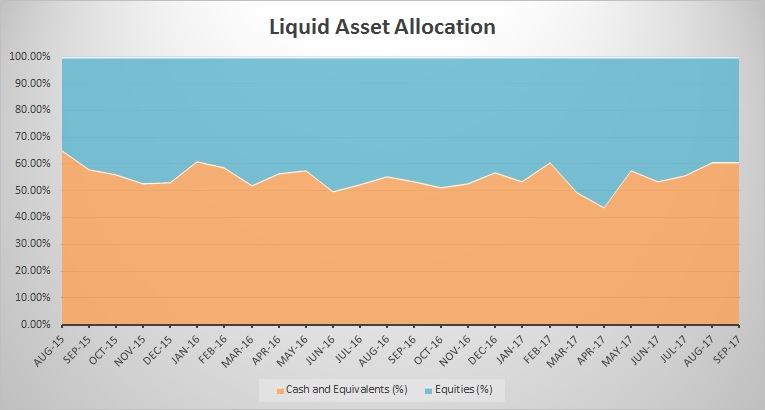
Using my monthly records tracing back to 2 years ago, I further calculated what was actually my asset allocation. Being a retail investor there was not much asset classification I could choose from. It will probably be Equities, Cash and Bonds. I could further break my equities into strategy groups as per my example above much it would not make much sense due to my limited capital.


When the chart above was generated, I was actually pleasantly surprised at how consistent the allocation was! My total asset was not stagnant as I had transition from a student to a working adult in this two years of data. I was not tracking the allocation at all. But subconsciously, I was able to move my asset around to achieve that consistent level of allocation. 

When my first salary started, I actively sought stocks to invest in. When I overbought stocks, I try to sell away one other counter to balance my exposure. Somehow along the way, I maintained this average Equities allocation of 44%. 

While I looked like I did not need this asset allocation, what I learnt at my workplace is to have the discipline to set the allocation and follow it, subject to any review. While I am more comfortable at the current allocation between Equities and Cash, I know I should either 1) Increase allocation to Equities or 2) Move some cash and diversity into Bonds. This is because as a young adult, I should be taking on high risk given my long investment horizon. Either of these two methods will make my cash work harder and I will be taking some action soon. 

3) Tracking Portfolio Properly

The last thing I learnt from office was probably how to properly track my portfolio. This is primarily because I learnt the different classification types that the investment team uses, and slowly adopt it to mine! 

Some difficulties I faced before was to include or exclude:
  • CPF
  • A sum of money that someone owes me, and 
  • Cash value of my insurance policy
In my old tracking, I included the last two assets accounts but not CPF, as part of my Total Assets. In addition, I lump all the monies into a single number as displayed below. 


Now that I have some sort of structure to my asset classification, I wanted to retain the use of the Cash and Equities composites in my Total Assets record. After a few days of side thoughts while working, I decided to classify the 3 pointers above as Illiquid Assets, in addition to the Cash and Equities asset class. The below chart was the last change I did to my net worth tracking. 


With this I am able to visualize how each of these asset types makes up my Total Assets while being able to monitor the total asset growth. For myself, it is very interesting to see how my CPF begins to balloon in size after I entered the workforce. 

Another unsettling observation I can draw from this is that CPF is a growing component of my Total Assets. In theory, CPF should contribute 17% + 20% of my basic salary. My take home salary should be 83% of basic salary. A quick conclusion will be that I am spending a lot such that CPF grows relative to my liquid assets! (On hindsight, it might be the $5,000 NSmen incentive).

In this post, I shared what are some of the lessons I brought home from work. As my tenure grows, I foresee I will try out more features which I taught will be useful. It is exciting and fulfilling to have enjoy what I do at work and I hope this feeling will be here to stay. As Dow continues to march towards 23,000, let's put on our critical hat and start to fear when everyone is greedy.

Sunday, 20 August 2017

Review of my Sitra Holdings Purchase (5LE.SI)

I rarely buy any stocks based on people's recommendation, at least not without going through their rationale first. However recently, I bought Sitra Holdings based on the call made by The Little Snowball. Their case made for Sitra was fair and substantiated by (or very similar to) previous analyses found here and here. I entered at $0.017. 

Disappointingly, Sitra's 1H2017 results did not deliver as expected, with losses increasing from $245,000 to $643,000. 


Voluntary Salary Deduction

While most analyses had been lauding the company's steady trajectory to an eventual profitability, they have missed out a component enabling that - voluntary management's salaries reduction. Senior management previously took a pay cut to ease the finances of the company. These voluntary salary deductions were reinstated in the latest set of results and indeed, selling and marketing expenses together with administrative expenses increased. 

Senior management reinstating their salary arrangements may be a good sign that company is turning around and they are more comfortable receiving their original salary. However, this factor may have been "beautifying" previous results and maybe the path to profitability may not be as straightforward after all. 

Forex Losses

While results were not fantastic in this half year, peeling back the forex losses will reveal a nicer set of numbers. Ignoring forex losses of $0.43M parked under other losses - net, the losses narrow to $213,000 which is definitely an improvement from the previous 1H result. 

Conclusion

Taken together, it is fair to conclude indeed, the finances of the company are improving if the above two points were factored out. However, senior management fees should be the rule rather than exception and hence the company do have to work a bit harder to eke out profits.

Looking at the cash flow statement, Sitra only has $2,000 cash at the end of the period, paralyzed by high trade receivables and bank overdrafts. This is another area that the company has to brush up on to survive the next economic downturn. Hopefully, rights issue will not be called as I do not hope for a long-drawn investment in Sitra. If need be, I am willing to dispose this stock at a loss as my capital outlay is purposely kept small due to the speculative play. 

Saturday, 22 July 2017

Half-Year Portfolio Review

Half-Year Portfolio Review

2017 was the first full year that I am working full-time and this has taken time away from my investment hobby and more or less contributed to a poor performance against the STI. As I had written in haste previously, I bought and sold stocks in frenzy in order to ride the wave of the bull market. Thereafter, I calmed down slightly to properly review my portfolio and make a mental note of which is a investment stock and which is a trading stock. For myself, I separate my stocks according to these two types and my strategies differs respectively.

Investment Stock -

  • Stocks are researched to some degree before buying
  • Investment horizon is generally longer
  • Willing to take some loss in order realise the supposed value (current limit is 30%)
  • Embarrassingly, I do not have a proper exit plan yet (this is the reason for why SingPost is utterly dragging my portfolio down or else I usually wait for an event that trigger me to sell ie. takeover, market starts turning down)
  • Recent example: Tianjin ZX, ST Engineering, Falcon Energy and HPH Trust 

Trading Stock -

  • Stocks are bought on sentiments though I do make sure there are some safety nets like an existent dividend yield and reasons for the stocks to chiong
  • Usually sold when there is a quick gain 
  • Stop-loss limit to a tune of -5% or when I know there is no longer any impetus for stocks to chiong 
  • Recent example: HC Surgical, M1, HRnetGroup (I bought and sold M1 and HRnetGroup within such a short window that I did not update here)
When I group the stocks according to my objectives, I am more prepared when the prices actually hit the sell price, be it a profit or a loss. Therefore, I advocate to investors out there to know the difference between investing and trading. While I had advocated for a investment slant, I do trade from time to time to feed the itch.

Dividends

In my 2016 Investing Report Card, I had made $1100 as the dividend target to hit this year. As of me writing this post on 16 July, I have accumulated $635.39 in dividend or 57.76% of the target. While it is lagging behind the time equivalent of the year, it will catch up eventually as some stocks do not declare every quarter. However, given the poor performance of SingPost, I will eventually miss my dividend target this year unless I heavily increase my capital. I am not inclined to do so as the market is very high right now.  

Performance

For the first 6 months this year, I have accumulated a XIRR of 2.867%. This return is abysmal compared to the general market. This is really attributed to the fall of SingPost, which is frankly quite unrelenting. SingPost has been the gem in my portfolio and I have refused to sell it despite the many pitfalls and signs it had been displaying. The advice of not falling in love with any particular stock is really true in this case and I have been considering to write a post on how to sell a stock in order to keep myself disciplined.

However, as I am only writing this half-year review post now in July, there had been a offer for GLP to be taken private amongst other movements and I hope it will contribute to an improved full year returns.

So that's all for my half-year review. STI has been huat huat for a while now and I feel that there are increasingly lesser value stocks around. The theme should switch to hunting turnaround stories as the bullish market will handsomely reward these turnaround. At the same time, we should be nimble in our buying or selling so as to not be caught off guard if the market turns. All the best in your investing journey!

Saturday, 24 June 2017

Tianjin Zhongxin Pharmaceutical (T14.SI)

Tianjin Zhongxin Pharmaceutical (T14.SI) is engaged in the development, manufacture and distribution of mainly Chinese traditional medicine. In addition to Chinese medicine, its products also include distribution of Western medicine operated jointly with pharmaceutical giants like GSK and Baxter.

Pharmaceuticals in SGX are far and few between and Tianjin ZX certainly piqued my interest. It first appeared in my radar while searching for stocks that have not ran up in this bull market, dividend-yielding, EPS growth in the past 5 years, reasonable market capitalization and in profit. Among all the stocks that appeared, Tianjin ZX had a good economic moat expected. of a pharmaceutical firm.

Digging up the past year's performance, Tianjin ZX was quite impressive as well.


In 2010, the Company reported 0.4 RMB in earnings. This rose to a high of 0.6 RMB in 2015 before dipping to 0.55 RMB in 2016. As shown in the graph above, NAV displayed an even better result. The Company grown from 2.43 RMB in 2010 to 5.38 RMB in 2016. This represent a CAGR growth of 14.16%.

S-chip is still viewed suspiciously by many in Singapore. Most recently, Eratat declared that it has no assets to be distributed to shareholders and delisted without any resolution to them. The cash declared to be held in banks were non-existent. However, Tianjin ZX pays a steady dividend year and this should imply that the cash were certainly present. For year of 2016, Tianjin ZX paid a dividend of 0.25 RMB. This is subjected to a 10% tax rate in Singapore and should amount to a final dividend of 0.225 RMB. At my buy price of 0.965 USD, this will translate to approximate yield of 3.4%. 

At current valuation, Tianjin ZX has a P/E of 11. For a pharmaceutical company, this P/E is somewhat low and have upside potential. For the latest quarter, the Company holds 536,481,000 RMB of cash, approximately 10% of share price. However, the crux of my purchase lies in this fact. Tianjin ZX is also listed in Shanghai at 17.65 RMB or S$3.58. At 0.US$965 or S$1.35, Tianjin ZX is listed in SGX at a 62% discount and 31.52 P/E!!!! I do not understand what caused the extent of this different valuation. However, I do hope that management will buyout my shares in and relist them at Shanghai for better returns. 

All this said, Tianjin ZX has been facing lower revenue but have been compensating by increasing operating efficiency and cost-cuts, leading to higher gross profit margins. In the latest quarter results, Tianjin ZX revealed that it is under challenging economic conditions and competitive environment. It is aiming to overcome these with the following actions:
  1. Placing greater emphasis on innovation and creation and establishing the importance of scientific development; 
  2. Strengthening its marketing plans to increase the amount of industrial sales so as to create more profits for the Company; 
  3. Focusing on research and development activities to enhance the Group’s core competitiveness in technology; 
  4. Strengthening the internal controls and management of the Group
Writing this post, I hope that Tianjin ZX will be deserving of my long-term investment and reap future returns. 


Sunday, 2 April 2017

Frenzy State

Caught up in a company project, I have not been devoting time to investing as much as I would like it to be. However, these past months, it had been disheartening to see the stock market rocketing while my portfolio languish due to legacy stocks and staying on the sidelines.

I've also been kicked a hard lesson with regards to doing my homework before investing in anything. I admit that I have been caught up in the frenzy of stock market, buying stocks without so much as doing some calculations. This few months, I had actually did some shuffle in my portfolio without much research. 

Here are some of my transactions I did without announcing it here due to a lack of time. From hindsight, most are of poor choice and I really attribute it to the lack of steadfastness in this volatile stock market. 

1) Sold ST Eng @ $3.62 (Wanted to take some profits off the table)
2) Sold Falcon Energy @ $0.128 (I capitulated on this stocks due to the poor outlook, it is not impossible to see this below 10c given the poor performance. However, it did rebound strongly last week to my dismay)
3) Bought Far East Orchard @ $1.685 (Bought on the day some cooling measures were announced. I have eyed this stock for a while due to it trading at a strong discount to book. Good dividend every year. Took into account some measure of takeover play as well)
4) Bought Serial System @ $0.186 (Sam Goi has been buying into it. It has a stable dividend history with good volume. Rare that a stock being "played" has a good dividend payout. Bought it with the hope of riding on Sam Goi's wave)
5) Bought Silverlake Axis @ $0.57 (Technology stock, steady dividend though business has deteriorated. Given that the economy seems to be recovering, a strong comeback in banks may give this stock some business. Waiting for the special dividend as well. Good potential overall with most risk due to its legacy short-seller's report)

As you can see, my investing has been haphazard and I am not proud of it. It is definitely not me. But the lack of time to invest, coupled with colleagues that check stock and telling me about their returns, coupled with the fear of losing out in the market spurred me to do this transactions. Hopefully they do not fail me. Last thing I want is to be caught in the peak of market as many had done before me. As of now, the stocks I had bought are not at astronomical valuation but it is not with the same level of undervalued-ness I had bought before.

Saturday, 7 January 2017

HC Surgical Specialists Limited (1B1.SI)

HC Surgical Specialists Limited debut on SGX Catalist on 3 Nov 2016 at $0.55 despite an IPO price of $0.27.

HC Surgical Specialists is a a medical services group primarily focusing on endoscopic procedures through a network of 12 clinics in Singapore. These clinics are distributed across heartlands and also in major private hospitals. In addition, the company has entered into a MOU with an independent party to provide training and consultancy at Transport Hospital in Vietnam. Their specialist surgeons will be registered to practice at the hospital and help set up a day surgery and endoscopy centre, thereby securing the exclusive rights to perform surgical and endoscopic procedures for a period of time.

Rational for Purchase

Bought this stock hastily on 6 Jan 2017 to take advantage of the $0.018 declared dividend. At my purchase price of $0.625, it is a 2.88% dividend yield - good for a growth and healthcare stock. I had only analyzed this stock retrospectively (flouting the rules, need to reflect on myself). Besides the attractive dividend for a healthcare stock, this stock caught my attention due to its similarity to another successful IPO by Singapore O&G, attaining multi-bagger returns.

  • Both are companies related to healthcare, though Singapore O&G focuses another field
  • Both had IPO price in the $0.20-$0.30 range
  • Both trading at P/E in excess of 30
  • Both declares dividend
  • Singapore O&G traded in the $0.60 range when it first debut
With these similarities, I am hoping HC Surgical Specialist will replicate the price trajectory as well. 

On a more fundamental basis, HC Surgical is good due to the following reasons.
  • Singapore is an ageing society, with more need for healthcare
  • Specialist medical services
  • Entry into Vietnam with clear business outlook

This is a superficial comparison that I should be ashamed of, but since my Buy Order was unexpectedly triggered, why not I publish this here as a record. 

Financial Performance


I had briefly looked through the half year financial statement before the purchase. With a quick peek, I gulped at the bottom line, with a 98.5% drop. I knew there was an IPO expense but did not have the time to add it back to compare. Now that it is the weekend, let's sit down and go through the numbers.

IPO expense was $1.258M. Adding it back to profit before income tax, it comes up to $1.357M - still 15% lower than the previous year. I factored in an increase tax expense to reach end profit of $1.357M. With outstanding shares post-IPO of 146,311,530. The EPS comes up to $0.0075 for the half year ended 30 Nov 2016.

Assuming consistent earning at the second half, the P/E at $0.625 is a whopping 42 - really going against my usual theme of value investing.

The declared dividend policy is to pay out 70% of its profit. With my estimated EPS of $0.015, the dividend payout is nearly 120% of profit. So this $0.018 dividend essentially has some parts coming out of the IPO proceed and I should not expect this rich a dividend in the future.

Maybe I have been pessimistic since finance costs will likely go down in subsequent quarters. New subsidiaries will boost earnings (with a chance expenses outpace it) and entry into Vietnam presents growth. But overall, I had find my purchase rather risky and not entirely based on fundamentals. Rather, it is speculative based on my comparison to Singapore O&G. In addition, HC Surgical had declared that "operating environment of the medical industry to remain challenging in the next 12 months..." 

However, a buy is a buy and I will like to see this stock still emulating the trend of Singapore O&G for a better Goat Year!

Sunday, 1 January 2017

2016 Investing Report Card

Year 2016 Closes, Results and Returns

2016 closes and with SGXcafe calculating returns on a daily basis, I knew what was coming before the year ended. Disappointingly, my portfolio underperformed STI ETF returns this year - the first time since 5 years of investment. With the negative losses last year, it was quite disappointing to have not grown my investment this year as well.

2016 Portfolio XIRR: -2.215%
STI ETF XIRR: 2.864%

Fun Facts

For now, let's lighten up the mood for some infographic about my portfolio movement this year:


Dividends Goals

With regards to $1000 the dividend goal I had set for 2016, you can see that I have narrowly missed it with $954.25. This partly due to Singpost's tightening dividend policy as well as Falcon Energy not yielding any dividend this year.

For 2017, I hope to increase my dividend received to the tune of $1100. Building up a portfolio that can gives me a steady income stream is one of my retirement goals for the long long term, and I hope that I am able to slowly accomplish this goal.

To increase the dividend, one way is to focus on purchasing stocks that are dividend-yielding and have the cash flow to support it. Monthly investment in STI ETF with my siblings will also contribute in a minor way, probably to cover the shortfalls from the dividend cut by Singpost.

Going Forward

Despite these two years of negative returns, I aim to keep the course. But it has certainly made me re-assess the way I look at gains. A problem is me not realizing profits only to watch it slip away and never coming back. One part of me always wants to be noble and be a "long-term investor". The other part is Graham's and Buffet's mantra of only buying companies where you will never give it up. Falcon Energy has been a bummer and I hope it proves itself in 2017.

For further pickings, I have a few stocks in my mind for research and considerations. Working gives me an steady income to invest but it takes time away from research and homework. But I hope to stay the course and just keep moving ---- towards financial freedom!


Saturday, 15 October 2016

Updates to Portfolio

It has been a while since I updated this blog of mine, the last post being in July after I bought Falcon Energy. So three months later, what has changed with my portfolio? Well, below are the three main things I would like to talk about in this blog post, to keep myself and you updated.

DCA on STI ETF

Since June this year, I've start contributing a small amount of money into dollar-cost averaging of STI ETF. This was done through POEMS ShareBuilder Plan. Though the fees were relatively higher than say POSB InvestSaver, I mitigated this consideration by pooling money with my siblings and buying it together. This way, the commission by percentage is comparable to POSB InvestSaver and I also get to enjoy the reinvestment option of dividend issued. 


Every drop of water contributes to the ocean. Buying STI ETF religiously every month will hopefully contribute to my retirement fund 40 years down the road. 

Bought more Falcon Energy


Hindsight is always 20/20. Before the results announcement, share prices were ranging as high as 19 cents - allowing me to exit with some profit. However, thinking it was a start to bull run in O&G, I decided to hold on. Without a dividend, coupled with the deterioration of the industries (think Swiber and Swissco's bond default), Falcon Energy was also brought down. 

However, its full year results were decent still and it left a big question mark for me. 4.92 US cents translates to a P/E of less than 3 leh! Cash generated from operations was US$111,747,000. There was a net decrease of cash because of hefty repayment of borrowings, which was the right thing to do in this environment where debt brings down O&G companies. Reflects the prudence of the management, to be frank. 

A strong argument I had previously was Falcon Energy stake in CH Offshore. CH Offshore's stock price had tanked recently and as of now stands at $0.29. This stake in CH Offshore translates to a value of $177M for Falcon Energy. Funny how at $0.16, Falcon Energy is valued at $129M. So, core business of Falcon Energy is valued at -$50M? 

With this, I've decided to further another round at $0.166. There are a few risks I am aware of and would highlight here for reference. 

1) Protracted depressed oil prices. Similar to the shipping industry, this would probably kill off many O&G companies. While the P&L looks good now, experience says that the bottomline will turn red in a quarter. 

2) CH Offshore revalues. A main reason why I invest in Falcon Energy was the stake in CH Offshore. It is not entirely impossible that CH Offshore becomes a penny stock, rendering its stock worthless. Then, what value to talk about? However, keep in mind CH Offshore does not hold significant borrowings and thus less likely to go under compared to say Ezra. 

3) Interest rate rises fast. In the annual report, every 50 basis points increase in interest rate will decrease Group's profit by US$801,000. US is increasingly likely to raise rate further this year. 

Planning to Sell Karin Tech

Should I....? Debating hard on this one, but already queueing at $0.315 to sell. 

Between China's diminishing economy, lowest EPS ever, and statement like this..,

"After the disposal of KCF A Store Limited, it is not expected the CEP segment will be able to fill the revenue and profit shortfalls in the near future even though the Group has been adding various prestige consumer electronics products into its product mix."

Totally feel like relieving myself of this company. The only thing holding me back from selling is the 7% dividend that was declared along this set of horrendous result. The management totally knows how to keep its shareholder. This is also apparent in its annual report where it shows that the company has already paid out 126% of the IPO price in dividend (within 10 years). Omg, if I hold for 10 years, will I be getting "free" shares as well?

Previously, I was scared that dividend paid out is no big deal as prices drop after the dividend was paid out anyway. But k1 Ventures totally proven me wrong on this point. Therefore, I am totally undecided.

Fundamentally, I should be getting out while stock prices are held up by the dividends. Emotionally, what about the dividends!!! T__T Help pls? 

Tuesday, 5 July 2016

Falcon Energy (5FL.SI)


Falcon Energy (5FL.SI) - One of the forefront in offshore marine and also O&G sector. It is divided into 5 business sectors namely, Marine, Oilfield Services, Drilling Services, Resources Division and one more that I couldn't find (LOL!). All this, you can read from their company website. Essentially, Falcon Energy feels like Nordic Group which provides O&G support services yet has a more direct exposure to oil prices through the Drilling Services and Resources Divisions.

I started searching for an O&G company as I wanted to gain some exposure to the potential oil price movements. Truthfully speaking, I did not do any deep research into oil prices. But seeing how far it has come down and the relative stability now, I wanted to capture some gains when the industry move into the up-cycle again. And I chanced upon this stock - a rare profit-making O&G company amidst the gloom and doom. Below are some of the points I like about this company:

1. Financial Metrics

Easiest go-to method to valuate a company from the surface. Was really too lazy to predict cash flows with expected oil prices etc. The ratios I calculated were really impressive till I started to doubt the going concerns of the company (the ratios were like that of a distressed company)!

Based on the time I did my calculations, where the price was at 17.2 cents and data obtained from the latest FY report,
EPS: 6.45 US cents
P/E: 1.975
P/B: 0.348
Debt/Equity: 0.9854
Dividend: $S 0.005 (2.9% yield interim)

In this set of data, it only seem that debt-to-equity ratio is high. I give it leeway as it is expected for O&G company to have significant debt, especially in these trying times. In addition, this 2016 figure is actually lower than 2014 and 2015, having paid off a sum of debt in the latest quarter. P/E and P/B is super impressive and actually needs no explanation. In the final dividend, I will guess that another half cent of dividend will be given out, ending with a near 6% yield. Warren Buffet had always like to buy stocks with significant higher book value and I actually think Falcon Energy fits the criteria.

2. Stake in CH Offshore

Falcon Energy actually owns 86.7% stake in CH Offshore, another listed firm on SGX. When I was doing this research on Falcon Energy, the market cap of the company was 139.2M while that of CH Offshore was 282M (sitting at 275M as of 06/07/16). This means the stake Falcon Energy has in CH Offshore is worth at least 244.5M! That's right, the market is selling the core operations of Falcon Energy for nothing and its stake in CH Offshore is valued at discount! This is the singular most blatant mispricing of Falcon Energy which I didn't believe. And if I calculated wrongly anywhere, please let me know to save me the money and embarrassment.

3. Share Repurchases

The company is aggressively doing stock buyback since 17 June 2016. The volume of the stock traded is not high, hence by aggressive, I meant as a percentage of the transacted volume that day. I suspect the company is doing so to meet the minimum trading price of 20 cents and since the volume is so thin, the company is able to do so easily - since there is little sellers blocking the queue. This is an situation that can be taken advantage of as the company is essentially being a guarantor of your entry price. It started doing buying back at ~16.8 cents till 19.5 cents today. In the last 2 days, it seems that there were some public support. As of now, still monitoring closely to see if the company is still going to support at current price.

 4. Conclusion

I had actually bought in at 17.7 cents on 27 June 2016, which I vaguely remember as the day Brexit occurred. I figured if it did not drop at such a dramatic event, surely it will grow when things got better. As my buy-in capital is small, I am not very tempted to take profit at current price. I hate to write this post as I do not want to jinx it (things are still going well) but in the spirit of sharing and also in the spirit of not being accused of hindsight-predicting, I have decided to write this post in the end.

NOTE: This post is not to comply you to buy the above-mentioned stock. Notice the price has actually gone up. Do your own due diligence before you take any action. To make sure you do indeed do your homework.... yes if you buy, you are helping me to prop up the share price!!


Cheers


Monday, 16 May 2016

DRP Calculations - Maximize your Dividends!

In a previous post, I had talked about the positive and negative aspects of Dividend Reinvestment Plan, or DRP in short. A key positive for DRP is the compounding feature which allows you to reinvest your dividends and snowball your assets. However, in the process subscribing for DRP, some of the dividends will be wasted due to roundoff calculations. This post teaches you how to allocate shares between DRP and cash so as to minimize wastage.

First off, dividends declared. 

Suppose your company has a DRP program and you want to subscribe to it. As an example, Keppel Reit declares a dividend and announces it on SGX website. This dividend consists of a few components such as taxable income, tax-exempt income distribution, capital distribution and other gains.


During my first attempt to claim scrip dividend, I learnt that new shares issued are counted not based on the lump DPU of 1.68 cents but instead, counted separately under each component and then summed together. This presents a problem as roundoff calculations are repeated at each component and it really eats into your allocated dividend. All the more important that you maximize your scrip dividends! 

So how to maximize?

Subscribing to DRP does not deprive you of cash dividend; you can do half-half. Basically in the DRP form you receive, you will be asked to allocate how much of your shares holding to count for cash dividends and how much to count for scrip dividend. 

Here lies the method to maximize your dividends:
  1. Allocate the minimum number of your shares holdings to DRP such that the new shares issued to you is the maximum
  2. Allocate the remaining shares holdings to receive cash

Example

Below is the Google sheet I created to address the above steps and you can download it here. 


The cells in orange need to be filled up by the user. The dividend structure is that of the example I shown at the top. The issue price of new shares is what you will be paying for using the dividend received. It is usually priced at a discount and announced separately later. In this case, it is $0.9802.

Suppose I have 3000 shares of Keppel Reit and I allocate it entirely to DRP, I will receive 49 new shares in total. However, if i decrease it by 1 share, I will still receive the same amount. Hence your objective is to find out what is the lowest Shares allocated to DRP so that the maximum new shares is still received then assign the remaining to receive cash.

Cost Savings?

Between 3000 shares and 2949 shares (which is the optimal) to DRP, there is an extra $0.85 that can be saved. This may be insignificant but it is a matter of principle to me. For others, that 10 minutes to save this $0.85 is worth it. 

Hopefully this post will save a lot more $0.85 going forward. If you know people doing DRP, do forward this post to them.   

Sunday, 1 May 2016

My Stock Holdings (April 2016)


After selling my HPH trust, above is the make up of my portfolio. Didn't receive any dividend for the month of April so refer to my dividend bar to the right.

Having started using SGXcafe near mid-April, I may eventually stop posting this monthly updates since I incorporated my portfolio data into the blog and you can see it any day of the month. I highly recommend this website to track your portfolio as it features many uses like calculating your variance (measure of risk) and beta. It assesses your portfolio to see which stocks you should add more through iAssist and also to recommends stocks outside your portfolio to reduce the level of risk (iSuggest). 

Do check it out!

Thursday, 21 April 2016

I'm selling HPH Trust (NS8U.SI)


Following HPH Trust's result announcement, I've finally decided to part ways with this stocks. In many posts here, here and notably here, I had voiced concerns about the sustainability of the dividends payout and the effect of China's slowdown. Unfortunately, due to procrastination and the time taken up by school work, I was unable to followup with a review of HPH Trust. On top of the 26% drop in underlying NPAT attributed to shareholders, this announcement also came with a very jarring note which stated it is:

"...repaying a minimum of HK$1 billion of debt annually beginning in 2017"


Dividend Issue

Woah, hold it right there. The amount is no small sum at all. Taking 2015's distribution amount which comes up to HK$2996.6 million or 34.40 HK cents per share, repaying HK$1 billion per year will cut this distribution amount to 22.92 HK cents or 33.3% drop!! Now, this is just purely assuming that the repayment solely comes from the hand dipping into the distribution income. Some might be taken from its existing cash pile...?

But take a look at Total Consolidated Cash at 31 March 2016: $5,995.6

It's not much at all. Keep in mind that HPH Trust need $1 billion per year for 5 years, not to mention servicing of short term debt. Another consideration is the dropping NPAT attributable to shareholders (no time to consolidate data, sorry!), which will eventually lead to decreased DPU. 2015's yield was exactly 8.0% based on my purchased price of US$0.68. Given that the first half of the dividend had already dropped 14%, the forecasted yield based on my purchase price is around 6.8% for this year. Conservatively taking out another 20% drop in DPU because of debt repayment, the dividend yield in 2017 will be just 5.5%!!. I had mentioned that my comfortable level was actually 6.5% and this violated my reason to buy/hold HPH Trust.

Will it fit into my portfolio?

5.5% is a decent dividend for any stocks and the fact that STI is one of the top dividend yield index in the region may just be because of HPH Trust! However, does it justify a place in my portfolio after all? I'll be using a concept I've learnt in my FIN3101 class (hello Prof Ruth!) - the Modern Portfolio Theory. 

I'm not going to explain in details about this concept, but in general it is about using diversification to bring the risk of a portfolio down to your acceptable level and get the best expected returns, through varying the weights of your portfolio components. 

To cut to the chase, I had actually found that by removing HPH Trust from my portfolio, the standard deviation or risk of the portfolio did not change and it was actually accompanied by a marked increased in expected mean return of the portfolio. This essentially signified that HPH Trust did not contribute to my portfolio in terms of risk and was actually detrimental in terms of expected returns. 

This was actually my first time using this method to analyze my portfolio and I was excited to find out about this fact! The photo below shows my calculation and any guru that may come by this humble blog can double check my workings. 


Seeing that future dividends are going to be cut and finding out that HPH Trust is useful in my portfolio, I have decided to sell this stock. Queued at US$0.465 all day to no avail, I will continue to try tomorrow or at least in the immediate term. 

Monday, 4 April 2016

My Stock Holdings (March 2016)

After a long wait, I can finally sit down and count my gains for the month of March! With the Singapore stock market in the doldrums for the first two months, there were finally some rebound even though I did not enter anything prior to it. However, as I also did not let go of any stock, it meant my portfolio clawed back some gains.

This also highlighted how investing is actually advantageous to constant trading. According to this article, missing just the best ten days of S&P in the period between 1993-2013 will cost the investor a 3.8% drop in annualized returns. While many will argue that trading is better as one can let go of stocks at the highest and buyback at a lower point, I can assuredly say that I neither have the skills nor the time. Hence, as a student and eventually a working adult, passive investing will still be the way to go.

On the matter of dividends, I received a total of $227.42 for the month of March. This amount was disbursed from HPH Trust, SingPost and Karin Tech. Hence for the first three months, the total dividends received comes up to $261.57, a little over a quarter of my dividend goal this year.

Also, I had bought GLP on 31 Mar 2016 for a cost of $1.955. A little high, but through the average of valuation methods which I may subsequently write about,  the fair value price of GLP I came up with was actually $2.42. Coupled with GIC being the majority shareholder, I feel that there is some merit to the purchase of GLP. With the addition of GLP, the breakdown of my portfolio is shown below. Let's hope 2016 is a good year for all in the stock market =)


Tuesday, 1 March 2016

My Stock Holdings (February 2016)

Whew, busy month with Design Project, FYP Presentation, projects, tutorials, midterms. For record sake's, I have come online to record this short entry of my stock holdings in February. Whilst the market condition is still bad, there is a restoration of stability and hence marginal growth.

In the month of February, Keppel Reit has declared a dividend of $0.0168 per share. I chose to reinvest this dividend through the DRP. While filling up the form, I realised that I can allocate the shares I own to either 1) Receive the cash dividend OR 2) Receive new shares. Knowing this, I can allocate some of my share to receive cash dividend while still receiving the same number of new shares. This is possible because there can be no shares lower than 1 and is thus rounded down. Might as well use this spare shares to receive the cash dividend! The amount is not huge, but I hate to give away free money.

Therefore, the first dividend I received this year will be $34.15. The start to my $1000 dividend aim for this year. Below is my stock holdings at the end of February. Noticeably, HPH Trust has fallen in overall value to stand below Keppel Reit.


PS: I finally found a job!

Friday, 5 February 2016

My Stock Holdings (January 2016)

Below is my portfolio distribution for the first month of 2016. Here's to a better investing future for the rest of the year! 


From the start of this year till end of January, the main movement was me selling Bank of Ireland in favor of Karin Tech. The sale of Bank of Ireland was triggered by the disappointing lack of positive push to the stock. Though the economy for Ireland and Europe had been improving for a while now, with stable dividend on the way, it had not translated into positive movement for the stock. The premise of me buying Bank of Ireland back in 2014 was based on the improving economy in Ireland as well as the improving of the bank's balance sheet. Both events happened without any significant price increase. Hence by referring to my buying motivation, I had realised holding the stock by this point, meaningless. This also serves as a good lesson for readers out there that when buying stocks, remember to write down your reasons for writing it. Periodically review it to see that the reasons are still valid and if the reasons are not valid anymore, consider selling it. 

Following the previous post about Karin Tech, I have decided to add the stock into my portfolio for the strength of management, resilient earning power, advantageous foreign exchange and good dividend. However, from the announcement from the company on Wednesday, I might have misjudged the strength of the business itself. Profits from Karin Tech plunged approximately 80% due to softening consumer electronics product. I had reservations about that section of business due to the low economic moat, but I did not expect it to drop so much. Nevertheless, a dividend of 0.05 HKD translate to a half year dividend yield of 3%. This is sufficient for me to consider holding it for longer periods of time. A warning to any investors though, the stock had fallen below the 3-year low of $0.285. Hence, a short term investor may have problem holding it. 

HPH Trust has also announced their results recently with a drop of dividend. A constant worry of mine is the huge debt of HPH Trust. Though HPH Trust has good dividends in the past years, the stock price drops along with the dividend and I wonder if the dividends/business is sustainable in the long year. I will be reviewing this stock with more spare time. 

SingPost announced marginal growth in profit despite higher revenue. It is really frustrating that profit does not grow proportionally with revenue. Logistics can be a lower margin business. However, having waited over 2 years for profit catch up, it does not appear to be happening. Management guided that "transformation" is finalizing and it is time to reap its fruits of labor. With the departure of Wolfgang Baier, I really wonder how the company is going to fare in the future. If not for my wonderful entry price, I may have sold this stock already. Perhaps I sound salty, but the downgrade from OCBC is infuriating. Within a quarter, the bank has conveniently slashed $0.82 off the target price of SingPost. While details has been lacking for the justification of the new TP, I find it unbelievable that the cut is so much within a quarter. Makes me wonder do the research house just see.... "heyyyy, the current trades so far from our TP. I think it's time to cut it nearer to current price to stay relevant." Also, I don't see eye to eye with people stating that dividend has increased from 1.25 cents to 1.5 cents. This is because it had been declared by SingPost since 1 year ago and should have been factored into stock price long ago. Don't mislead potential investors.


-End of whinings-

With the removal of Bank of Ireland, my portfolio has transformed into a full dividend machine and I hope I can meet my dividend target this year. The Year of Monkey should be good to people born in the Year of Goat and I hope it is true! So Happy Chinese New Year all! Have a prosperous year ahead!!

Monday, 18 January 2016

Karin Technology Holdings (K29.SI)

http://www.karingroup.com/eng/images/global/home_logo.gif

Business

Karin Tech is a leading electronic and industrial components distributor and providor of IT solutions, as well as outsourcing service provider in Hong Kong and China. In 2011, Karin included retail arm to its operations, opening four In-Smart stores in Hong Kong. . Though the business sounds unappealing, the surprising fact is this:

Since 1977, the company had always been in profit!

The company did not enjoy continuous EPS growth as its earnings were affected in the wake of 2008 GFC and in 2014. However, the fact that the board was able to maintain profitability despite many economic downturns is indeed commendable. The company also has a substantial economic moat due to its very diversified business. Listed on its Products & Services, Karin Tech looks like a semiconductor company and a IT solutions provider. Throw in the retail arm, Karin Tech has a hand in every section of the technology sector. The business not as exciting as companies like Apple or even Foxconn, but I particularly like companies that no one pays attention to.

Dividend

Business aside, let's look at the company's past dividends. The most attractive part of Karin Tech is actually a dividend yield that matches REITs and Business Trusts. Below is the dividend yield for 2013, 2014 and 2015. 

Year Dividend (S$) Closing Price for Year Dividend Yield
2013 0.0264 $0.33 8.00%
2014 0.0228 $0.30 7.60%
2015 0.0313 $0.31 10.10%


As you can see, the dividend yield for Karin Tech is substantial and comparable, if not better than many dividend stocks out there. Another point to note is the closing price for each year. Notice that the price is not volatile at all. Hence if you would are okay about not chasing capital gains but settle for dividends, Karin Tech is indeed very appealing. 

As with all dividend, one have to check how sustainable the dividend policy is. Below is the graph of how dividend payout correlates against EPS of the company. From the graph, you can see that management had discipline in keep dividend payout in line with EPS. Dividend payout average at approximately 50% throughout the years. Therefore, the dividends are indeed sustainable and payout are strictly adhered to by the management.


Valuation Metrics

From Yahoo website, the P/E of Karin Tech currently stands at 8.16. For a company that is relatively low profile with not as "attractive" business, I would say that the P/E is reasonable but leaves room for upside. For P/B, I referred to POEMS Stock Analytics and yield a figure of 0.56. Both P/E and P/B indicated that the margin of safety is relatively large. A downside I identified is actually how the stock rolls with the dividend payout. For example in 2010, when 8.2 HK cents of dividend was paid, the year end price was $0.22 - 6.5% yield (ignoring currency). Market historically had priced this stock to yield high dividend, which means that upside might be limited as well.

A catalyst that warrants a share price increase is the fact that HKD, by proxy of USD had already increased against SGD. Since HKD is pegged to USD, the stronger USD meant that the earnings of the company will be higher. Also, dividends paid out by the company is denominated in HKD, which might potentially mean higher payout. Most of the time, I feel that the market do not pay much attention to currency exchange (maybe because the companies always strip of forex gain/loss anyway) but in this case where dividend is transacted in HKD, perhaps this Karin Tech might be worth a look.

I'm none the wiser about the general strength of the industry. However, judging from the slowing economy in China, perhaps Karin Tech might be negatively affected by it. But, it is definitely worthwhile to note that the strength of management will make me comfortable holding the stock long-term and ride out downturns with them, all the while collecting the dividends they give out.

Valuation

The historic EPS growth between 2004 and 2015 was 5.87% annually. Projecting CAGR forward, the EPS in 2017 will hit 0.3295 HK cents or approximately $0.06. Applying the same P/E of 8, the simple projected price of Karin in 2017 should be around $0.48 (share increase in excess of 50%).

The current value arrived using Gordon Growth Model is looks even more monsterish. From Reuters, the beta of Karin Tech is 0.21. Re-using the risk-free rate and market's rate of return from previous post, the required rate of return or discount rate amounts to 3.465%. In 2005, the dividend was 6 HK cents while in 2015, it was 17.6 HK cents. Taking into account that 2015 was a record profit year, I will slightly adjust the "ending" dividend to 15 HK cents. Thus in the span of 10 years, the dividend growth of Karin was 9.6%. If you realise, the discount rate is actually lower than dividend growth and hence lead to a negative stock price (technically not possible).

Hence, an alternative will be to lower expectations and change using Constant Dividend Growth to valuate the company. Let's lower expectations even further and assumed that the upcoming year's dividend is 10 HK cents (44% drop). Using the formula, the current stock price for Karin Tech should be HK$2.89 or S$0.52.

Conclusion

 From the valuation section, you can see how horrifyingly undervalued Karin Tech is. However, there are some issues to consider. One would be the continuation of business and dividend. Will dividend continued indefinitely? Is the survival of business a cause of concern? Perhaps the growth of the entire business will be in jeopardy in the near future due to slowing economy of China.

However:

  1. P/E and P/B are very low, similar to unfavoured industry. Given that it is a high dividend yield stock, I think it should command higher valuation
  2. Business had always been profitable. Good economic moat
  3. The company had been faithfully declaring dividend for the past 10 years
  4. Recent hike in US$ (of which HK$ is pegged to) against S$, translating to higher dividend

Given all these reasons, I think Karin is  a safe bet and have taken a small position. 

Saturday, 16 January 2016

2015 Investing Report Card

In my previous post, I mentioned that my "financial year" ends on 13 January 2016, since it was the date I started tracking 2015 investment returns. Now that the day had past and I finally handed in my Final Year Project report, I can finally sit down to type out this post!

2015 Annual Return: -10.412% (for year ended 13 Jan 2016, using Excel's XIRR function)

With a portfolio that is down more than 10%, it was definitely not a good year for me. The consolation is that using the same calculation metric, the 2015 return for STI ETF was actually -16.099%. 

Hence comparing my portfolio against the STI index, I had technically "beat the market" for the year of 2015. Since many books had mentioned professional fund managers have trouble beating the market, I take pride that I had achieved the feat in 2015. It was a tough year especially with China's economy not doing well and oil price being so depressed. As a graduating student, I can sense that Singapore's economy is not doing well at all. This is so because of the tight job market available for me. My wish for 2016 is for me to get a job and start my own monthly investment plan, putting a part of my salary in STI ETF. I do not mind that the stock market tanks because over the long term, buying in a bear market inflates your returns. Buy when others are fearful!!

Note: Recently, someone introduced me to Holding Period Return as a way to calculate portfolio return, instead of XIRR. I am still not sure which is more accurate. Hence for 2016, I will keep track of my investments using both methods and observe how far they deviate from each other.


Here are some of the fun facts about my portfolio performance in 2015:

  • Dividends are probably the reason why my portfolio managed to outperform STI ETF - receiving $863.19. 
  • Dividend yield for portfolio is 4.80%, Excluding stocks that did not give dividend, the yield goes up to 6.17%.
  • I'm not a perfect investor. I trade sometimes (or technically, gamble). With 5 sets of Buy-Sell trades, I made a loss of $438.45. Portfolio return would have been better if my hand had not got itchy.
  • Narrowly missed losing a whole lot more if I did not sell Ezra in time. Ezra closed at $0.0900 that same day.

  • 2015 was also a bad year because none of the stocks I bought for investment purposes finished the green. Stocks included K-Reit, k1 Ventures and Straco. The only positive investment which I sold off was Apple Inc, which I bought in 2014 and sold in March 2015. 

2015 was an overall bad year while 2016 remains uncertain and volatile. Within the first 2 weeks, STI had already dropped 8.46% and the future of oil rigs giants KepCorp and SembCorp look threatened. Having started investing in 2011, I have not met any bear market or recession. No one can claim to be "experienced" if he/she have not gone through a financial crisis. Hence I am actually excited for 2016! Bull or bear, I will still be in the market, seeking my private returns.